Billing
·
9 min read
The 2027 ICD-10 codes for physical therapy take effect Oct. 1, 2026.
PS
The PatientStudio team
Practice operations
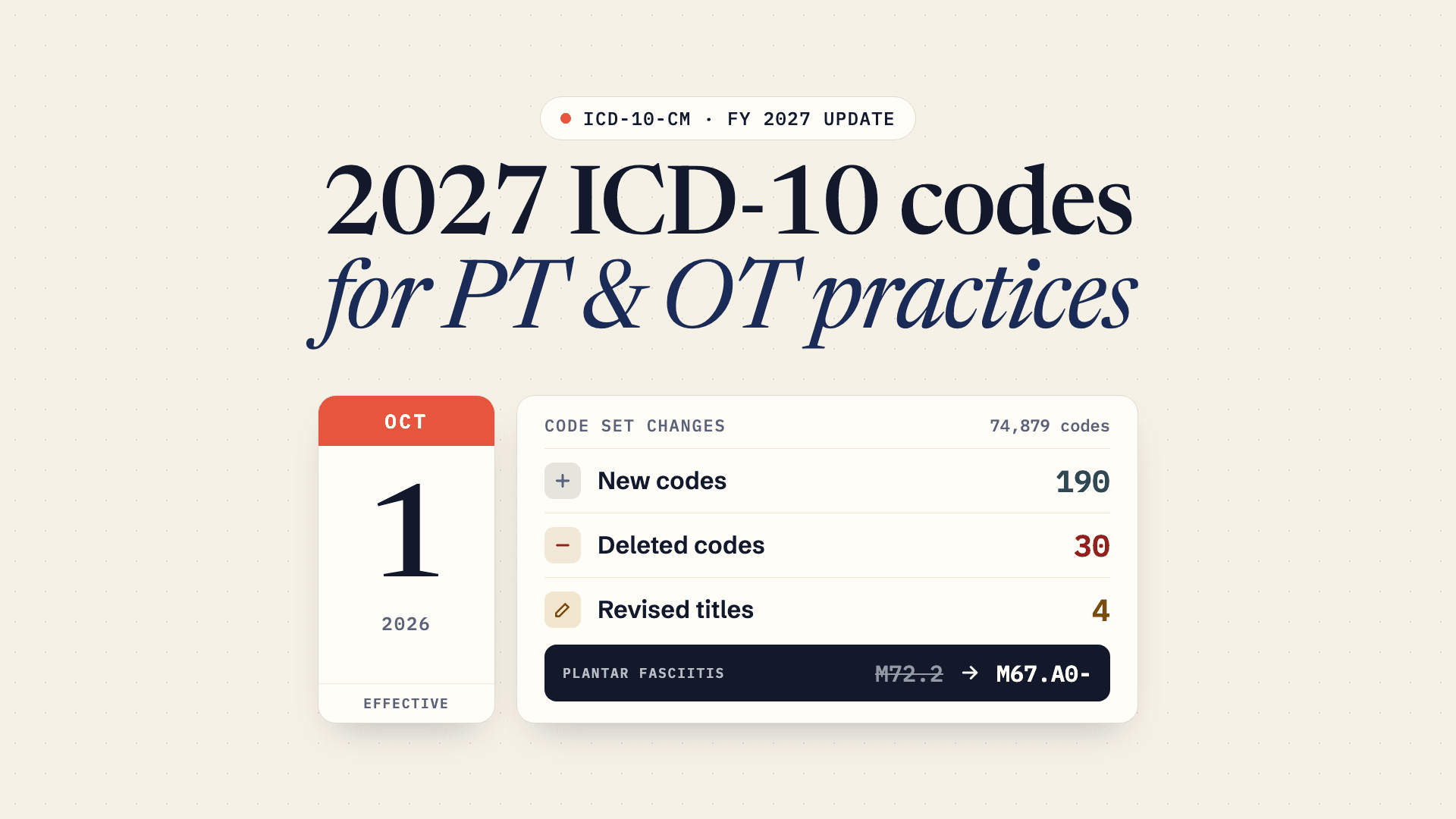
The 2027 ICD-10 codes for physical therapy take effect on October 1, 2026. On that date, every PT and OT claim switches to the new FY 2027 ICD-10-CM code set. There’s no grace period. A diagnosis code that was deleted will get the claim rejected, even if that code was fine on September 30.
This year’s update is smaller than some. But one of the changes hits a diagnosis nearly every outpatient orthopedic clinic bills each week: plantar fasciitis no longer lives at M72.2. This guide covers when the rules change, which new, deleted, and revised codes matter to rehab therapists, and what practice owners and billers should do before their first October visit.
When do the 2027 ICD-10 changes take effect?
CMS and the CDC’s National Center for Health Statistics released the FY 2027 ICD-10-CM files over the summer. According to CMS, the codes apply to patient encounters from October 1, 2026 through September 30, 2027.
Three things billers get tripped up on:
It’s called “2027” but it starts in 2026. ICD-10-CM follows the federal fiscal year, which begins October 1. FY 2027 is the code set in effect from October 2026 to September 2027.
The date of service decides which codes you use, not the date you submit the claim. A visit on September 30 that you bill on October 6 still uses FY 2026 codes. A visit on October 1 uses FY 2027 codes, whenever it gets billed.
ICD-10-PCS doesn’t apply to outpatient therapy. CMS also published FY 2027 ICD-10-PCS procedure codes, but those are for hospital inpatient procedures. Outpatient PT and OT bill procedures with CPT and HCPCS, and diagnoses with ICD-10-CM.
The 2027 ICD-10 update by the numbers
According to the official CMS FY 2027 code files, the update includes:
190 new codes
30 deleted codes
4 revised code titles
74,879 total billable codes, up from 74,719 in FY 2026
Most of the new codes are outside rehab: ectopic pregnancy, toxic-exposure injuries, cardiomyopathy, and genetic cancer syndromes. The changes that matter to PT and OT sit in the musculoskeletal chapter, the gait and mobility symptom codes, and a few injury and comorbidity codes you may pick up from referrals.
Change | Old code (invalid 10/1/26) | Use instead | Who it affects |
|---|---|---|---|
Plantar fasciitis moves to its own subcategory | M72.2 | M67.A01, M67.A02, M67.A09 | Ortho PT, foot and ankle, sports |
Plantar fascial fibromatosis (Ledderhose disease) gains laterality | M72.2 | M72.20, M72.21, M72.22 | Ortho PT, foot and ankle |
Difficulty walking and unsteadiness on feet can now be coded together | No code deleted (instruction note changed) | R26.2 + R26.81 when both are documented | Gait, balance, fall-risk, neuro, geriatrics |
Sternoclavicular joint sprain removed from thorax chapter | S23.420A, S23.420D, S23.420S | S43.6- (with laterality and 7th character) | Ortho, shoulder, sports |
Other osteomyelitis gains laterality | M86.8X1 through M86.8X8 | M86.8X11 through M86.8X89 | Hand therapy, OT, post-infection rehab |
Spinal cord injury sequencing with thoracic fractures | No code deleted (sequencing note changed) | SCI code (S24.0-, S24.1-) goes first | Neuro rehab, SCI programs |
The big one: plantar fasciitis moves from M72.2 to M67.A
For years, plantar fasciitis and plantar fascial fibromatosis shared one code: M72.2. Starting October 1, 2026, they’re split apart:
M72.2 is no longer billable. It becomes a category heading, and plantar fasciitis is removed from its inclusion terms. The category is now only for plantar fascial fibromatosis (Ledderhose disease), the condition where firm nodules form in the plantar fascia.
Plantar fasciitis gets a new home in category M67 (Other disorders of synovium and tendon): M67.A01 (right foot), M67.A02 (left foot), and M67.A09 (unspecified foot).
Ledderhose disease gets laterality too: M72.20 (unspecified foot), M72.21 (right foot), and M72.22 (left foot).
Diagnosis | Through 9/30/2026 | Starting 10/1/2026 |
|---|---|---|
Plantar fasciitis, right foot | M72.2 | M67.A01 |
Plantar fasciitis, left foot | M72.2 | M67.A02 |
Plantar fasciitis, unspecified foot | M72.2 | M67.A09 |
Plantar fascial fibromatosis (Ledderhose), right foot | M72.2 | M72.21 |
Plantar fascial fibromatosis (Ledderhose), left foot | M72.2 | M72.22 |
Plantar fascial fibromatosis, unspecified foot | M72.2 | M72.20 |
What to watch for with plantar fasciitis
Don’t just add a digit to M72.2. The easy mistake is to pick M72.21 or M72.22 because they look like the old code. Those codes now mean fibromatosis, not fasciitis. Using them for heel pain from plantar fasciitis puts the wrong diagnosis on the claim.
Document which foot. The new codes reward laterality. Therapists should chart right, left, or both feet at evaluation and re-evaluation so billers aren’t stuck with M67.A09.
Bilateral plantar fasciitis means two codes. There is no bilateral code in M67.A0-. Under the official laterality guideline, when a condition is bilateral and no bilateral code exists, you report both the right and left codes: M67.A01 and M67.A02.
Open plans of care need updating. Any patient currently treated for plantar fasciitis under M72.2 needs the new code on claims for visits on or after October 1.
Gait and balance: R26.2 and R26.81 can now be coded together
This change doesn’t add or delete a code. It changes an instruction note, and it matters to any clinic that treats gait, balance, or fall risk.
Under R26.2 (Difficulty in walking, not elsewhere classified), the note for R26.81 (Unsteadiness on feet) changes from an Excludes1 to an Excludes2:
Excludes1 means “never coded together.” The two conditions are treated as mutually exclusive, so you had to choose one.
Excludes2 means “not included here.” The conditions are separate but can exist at the same time, so you can report both when both are present.
Starting October 1, a patient whose evaluation documents both difficulty walking and unsteadiness on feet can carry both R26.2 and R26.81. That gives a fuller picture of medical necessity for gait training (97116), neuromuscular re-education (97112), and balance-focused therapeutic activities.
The usual rule still applies: code what’s documented. Your evaluation needs objective findings for each problem, such as gait speed, assistive device use, Berg or TUG scores, or observed loss of balance. Don’t stack codes just because the rules now allow it.
Other 2027 ICD-10 changes PT and OT teams should know
Sternoclavicular joint sprain (S23.420 deleted)
The thorax-chapter codes for a sternoclavicular sprain (S23.420A, S23.420D, S23.420S) are deleted. The shoulder-girdle codes for a sternoclavicular joint sprain in S43.6- (S43.61- right, S43.62- left, S43.60- unspecified) are still valid and include laterality. Remember the 7th character: A for initial encounter, D for subsequent encounter, and S for sequela. Most outpatient therapy visits use D.
Other osteomyelitis gets laterality (M86.8X-)
Eight “other osteomyelitis” codes by site (M86.8X1 through M86.8X8) are deleted. They’re replaced by 24 seven-character codes that specify right, left, or unspecified side, plus new site codes for the skull and for the face and sinuses. For example, osteomyelitis of the right hand is now M86.8X41. OT and hand therapy clinics treating patients after a bone infection should update any open cases.
Spinal cord injury sequencing with thoracic fractures
Under S22 (Fracture of rib(s), sternum and thoracic spine), “Code also spinal cord injury” becomes “Code first, if applicable, spinal cord injury (S24.0-, S24.1-).” When a patient has both, the spinal cord injury code now goes before the fracture code. This matters most for neuro rehab and inpatient rehab settings.
Stroke scale codes (R29.7-)
The “code first” note for NIH Stroke Scale scores now lists hemorrhagic strokes (I60.-, I61.-, I62.-) as well as cerebral infarction (I63.-). Hospital-based therapists who report NIHSS scores for hemorrhagic stroke patients can now link them correctly.
Comorbidity codes that may arrive on referrals
Therapists don’t usually diagnose these, but they often show up as secondary codes on referrals and intake forms. Each of these was deleted and split into more specific codes:
I42.0 Dilated cardiomyopathy → I42.00, I42.01, I42.09 (relevant for cardiac and pulmonary rehab)
I42.8 Other cardiomyopathies → I42.81, I42.89
I49.8 Other specified cardiac arrhythmias → I49.81, I49.82, I49.89
Z68.1 BMI 19.9 or less, adult → Z68.18 (BMI 18.4 or less), Z68.19 (BMI 18.5–19.9)
D69.1 Qualitative platelet defects → D69.11, D69.19
A physician order written in September may still list one of the old codes. The patient’s condition hasn’t changed, only the code has, so translate it to the valid FY 2027 code on your claim instead of copying the referral as written.
New exposure codes for veterans
New codes cover exposure to burn pits (Z77.32), Agent Orange (Z77.33), and blast overpressure (Z77.40–Z77.49). If your clinic treats veterans through VA Community Care, especially for traumatic brain injury, vestibular problems, or chronic pain after blast exposure, these codes can document relevant history when the provider records it.
What about patients already in a plan of care?
The switch on October 1 doesn’t wait for your plans of care to end. Here’s how to handle patients who are in the middle of an episode:
Update the diagnosis on October visits. Every claim with a date of service on or after October 1 needs a valid FY 2027 code. Update the treating diagnosis in the chart so notes, the plan of care, and claims all match.
A code update isn’t a new plan. In most cases, replacing a deleted code with its successor is an administrative change, not a change in the plan itself. It shouldn’t trigger a new certification on its own. If you’re unsure about a specific payer, check with your MAC or the payer.
October 1 checklist for PT and OT practice owners and billers
Confirm your EMR and clearinghouse have loaded the FY 2027 code set. Ask your vendor directly. Don’t assume it’s done.
Run a report of active patients with M72.2, S23.420-, M86.8X-, I42.0, I42.8, I49.8, Z68.1, or D69.1 on their current diagnosis list, and update each one.
Clean up favorites and pick lists. Remove M72.2 from favorite-code lists, superbills, and cheat sheets, and add M67.A01, M67.A02, and M67.A09.
Brief your therapists. Five minutes at a team meeting covers it: document which foot for plantar fasciitis, never use M72.2- for fasciitis, and chart both walking difficulty and unsteadiness when both are present.
Watch rejections closely for the first three weeks. Invalid-diagnosis rejections usually come back from the clearinghouse within a day or two. The earlier you catch a pattern, the fewer claims you’ll need to rework.
If you want a refresher on the codes that didn’t change, our guide to common ICD-10 codes for physical therapy covers code structure, 7th characters, and the diagnoses rehab clinics bill most.
Frequently asked questions
When do the 2027 ICD-10 codes take effect?
The FY 2027 ICD-10-CM codes take effect for dates of service on or after October 1, 2026, and stay in effect through September 30, 2027.
What is the new ICD-10 code for plantar fasciitis?
Starting October 1, 2026, plantar fasciitis is coded M67.A01 (right foot), M67.A02 (left foot), or M67.A09 (unspecified foot). For bilateral plantar fasciitis, report both M67.A01 and M67.A02.
Is M72.2 still a valid code?
No. For dates of service on or after October 1, 2026, M72.2 is no longer billable. Its new subcodes, M72.20 through M72.22, are only for plantar fascial fibromatosis (Ledderhose disease), not plantar fasciitis.
Is there a grace period for the 2027 ICD-10 changes?
No. Claims for dates of service on or after October 1, 2026 must use valid FY 2027 codes. Claims with deleted codes will be rejected as invalid.
Can I bill R26.2 and R26.81 together?
Yes, starting October 1, 2026. The Excludes1 note under R26.2 was changed to an Excludes2, so difficulty in walking and unsteadiness on feet can both be reported when both are documented.
Do the 2027 changes affect occupational therapy?
Yes. OT clinics should update M86.8X- osteomyelitis codes (now with laterality, which matters for hand therapy), the sternoclavicular sprain deletion, and comorbidity codes such as cardiomyopathy and BMI that may appear on referrals.
Make October 1 a non-event
Every year the code set changes. The practices that get through October without a pile of denials are the ones where documentation, the plan of care, and claims all come from the same place, so one diagnosis update carries through everywhere. See how PatientStudio’s billing and documentation tools help PT and OT practices keep diagnosis codes and claims in sync, or schedule a demo to walk through it with our team.
Sources: CMS FY 2027 ICD-10-CM code files, tabular addendum, and conversion table (cms.gov), and the FY 2027 ICD-10-CM Official Guidelines for Coding and Reporting. This article is for general education. Always confirm payer-specific requirements with your MAC or commercial payer.
Find out what your practice is leaving on the table
A 30-minute walkthrough of billing, verification, and the AI agents — on your numbers.